Blonde hair, blue eyes, and fair skin can look striking in clothes that are not especially loud. The useful question is not which shade will magically make eyes brighter; it is how much contrast, warmth, and depth your own coloring can comfortably carry. A blue shirt may look effortless on one blonde person and rather severe on another. Looking at the whole effect in daylight gives a better answer than a color-season label alone.
Start with the contrast you actually see in the mirror
Many people searching for the best clothing colors for blonde hair, blue eyes, and fair skin are told to begin with eye color. Hair and skin usually set the volume first. Pale blonde hair and fair skin often create a soft overall contrast, so a black top beside the face can arrive before the person does. That does not make black forbidden; it simply means it often needs a softer companion, such as faded denim, a pearl earring, or a neckline that leaves some skin visible.
Try a small comparison at a window: hold navy, charcoal, soft white, and true black under your chin. Notice whether shadows around the nose and under the eyes deepen, and whether your skin looks pinker, yellower, or clearer. The winning color does not have to make your eyes look electric. It should make the face look rested, because that is the effect people notice across a table or in a meeting.
Use blue to echo the eyes without matching them exactly
Blue is often the safest starting point for blonde hair and blue eyes, but the useful blues are broader than a single sky-blue sweater. Washed denim, smoky blue, periwinkle, slate, and a softened navy give different levels of definition. A medium denim blue is especially practical: it is casual enough for jeans and structured enough for a shirt, and it rarely makes fair skin look drained.
Matching an eye color too literally can look costume-like, particularly when the fabric is shiny or highly saturated. Instead, choose a neighboring blue and let texture do part of the work. A matte chambray shirt, a fine merino knit, or a cotton poplin blouse gives the shade a quieter edge. If your eyes are gray-blue, smoky blue and blue-gray are often more convincing than bright turquoise; if they are a clear icy blue, a cooler periwinkle may be the better test.
Choose light neutrals with more care than people expect
Fair skin is sometimes paired automatically with cream, beige, or camel. These can be excellent, but their undertone matters. A yellow cream can make cool pink skin look ruddy, while a stark optic white can feel clinical against very light hair. Soft white, oyster, stone, mushroom, dove gray, and cool taupe are useful alternatives because they create a gentle boundary without disappearing into the skin.
Check the color in the lighting where you really dress. A warm beige can seem friendly in a changing room with amber bulbs and oddly sallow on a cloudy commute. A neutral that works should leave a little separation between your jaw and collar. For an easy outfit, pair soft white with faded blue denim, or a mushroom knit with medium-wash jeans and silver-toned accessories. These combinations have enough structure without asking the face to compete.
Add pink, coral, and berry according to warmth
Blonde hair and blue eyes do not automatically mean cool coloring. Some people have peachy skin, golden blonde hair, or freckles that come alive beside warm shades. In that case, muted coral, watermelon, soft peach, and warm rose can be more flattering than icy pink. The caution is intensity: a vivid orange-red often overwhelms pale coloring even when the undertone is correct.
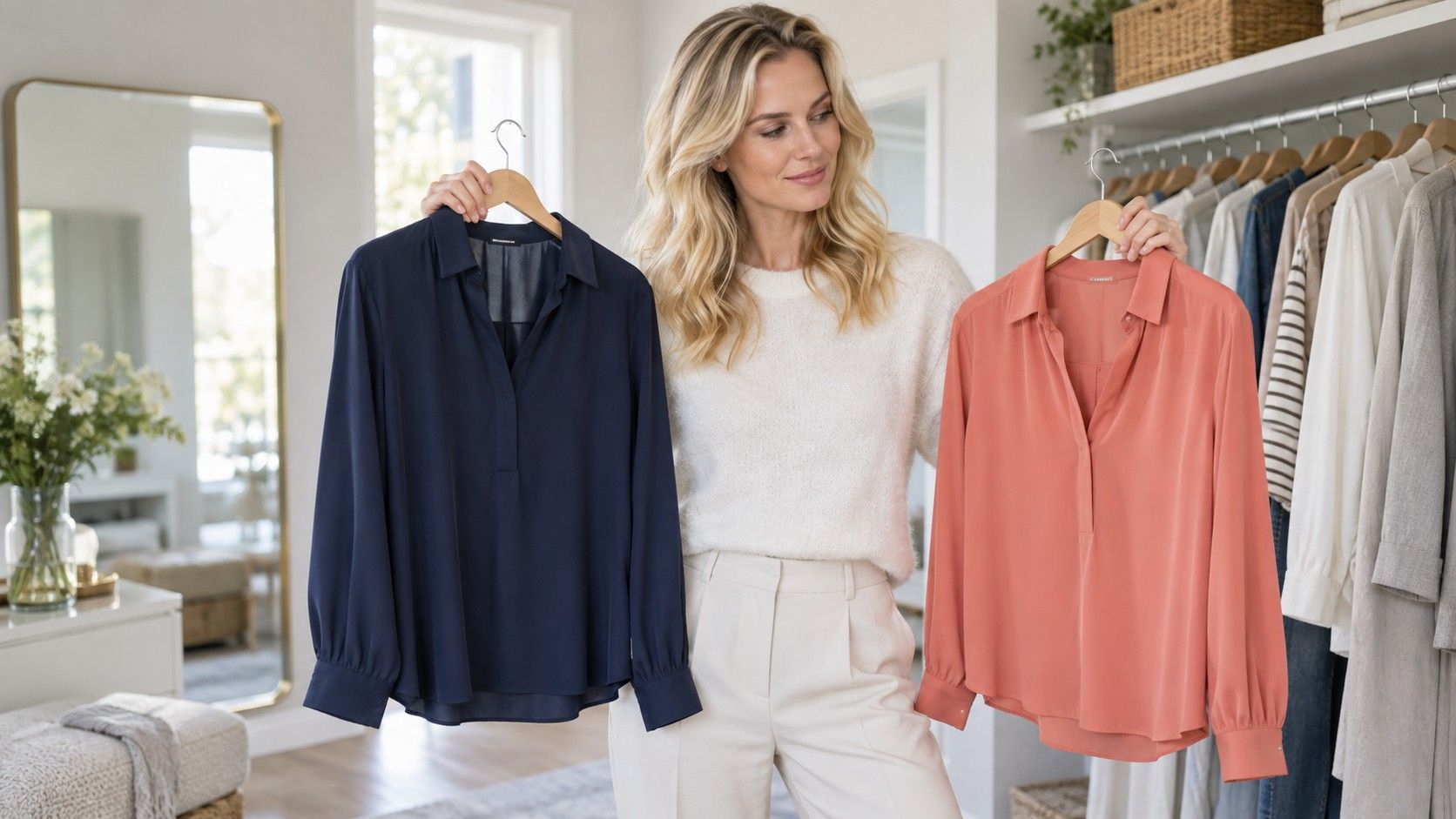
For cooler or neutral skin, dusty rose, raspberry softened with gray, mauve, and blue-red berry are usually easier near the face. Put two options on at once if you can: a coral tee and a muted rose tee tell you far more than a paint-chip quiz. The better shade makes lips look naturally present and does not pull attention to redness around the cheeks. Save the less successful color for trousers, shoes, or a bag, where it has less influence on the complexion.
Let navy replace black when an outfit needs definition
Navy earns its place because it can provide the clean line people want from black while staying friendlier to fair skin and blonde hair. The best navy is not always the darkest possible one. A softened ink navy, marine blue, or blue-black with visible texture can work better than a flat, almost-black fabric. It pairs naturally with soft white, pale blue, dusty pink, muted coral, and cool gray.
For work, try a navy trouser with a soft white shirt and a medium-blue knit rather than a full navy suit with a hard white blouse. For evening, a navy dress can gain shape from silver jewelry, a berry lip, or a small cool-pink layer. If black is still your favorite, wear it farther from the face: black trousers with a denim shirt, or a black skirt with a smoky-blue knit, keeps the clarity without making the whole outfit feel heavy.
A quick guide to colors worth testing first
| Color family | Why it can work | Practical caution |
|---|---|---|
| Denim and smoky blue | Echoes blue eyes and suits everyday fabrics | Skip very bright royal blue if it dominates the face |
| Soft navy | Provides definition without the harshness of black | Choose a visible blue cast rather than near-black |
| Dusty rose and mauve | Gives fair skin warmth or softness without shouting | Test against cheek redness before buying a large piece |
| Muted coral | Works beautifully with golden blonde or peachy skin | Keep it softened; neon coral is rarely forgiving |
| Soft white and stone | Create a clean, flexible base for layers | Compare them with your skin in natural light |
Build repeatable outfits instead of chasing a perfect palette
The most useful color wardrobe is made from combinations you will actually repeat. Start with two neutrals that behave well near your face, such as soft navy and mushroom, then add three accent colors: denim blue, dusty rose, and muted coral or berry. With that small group, a cardigan can work with several tops and a single pair of trousers does not force every outfit toward black.
Photograph a few successful combinations in morning daylight. This is more reliable than remembering that a shade seemed good after a long shopping trip. Include one relaxed formula, one work formula, and one evening option. For example: soft white tee, denim, and a smoky-blue overshirt; navy trousers, a rose blouse, and gray loafers; or a berry knit with a dark skirt and simple metal jewelry.
Keep the rules flexible and trust the final check
Color analysis can offer useful language, especially around warm and cool directions, but it cannot account for every haircut, tan, glasses frame, fabric, or personal preference. Blonde hair can be ash, honey, beige, or highlighted; blue eyes can be icy, gray, greenish, or very dark. Those details change the result more than a rigid label suggests.
When deciding between two colors, use the one that makes you look alert and feels easy to combine with what you already own. If a supposedly ideal shade feels precious, difficult to launder, or impossible to wear on an ordinary Tuesday, it is not doing much practical work. The best colors to wear for blonde hair and blue eyes are the ones that support your face, your routine, and the kind of clothes you reach for without negotiation.